
Photo courtesy of Pakistan PolioPlus
Committee.
Rotarians around the globe are planning events
to raise polio eradication awareness and funding for World Polio
Day on 24 October. Rotarians are getting ready to spread the word
about World Polio Day, 24 October, and the need to finish the job
of eradicating the disease. Photo courtesy of Pakistan PolioPlus
Committee.
Australian club members are working with the
Global Poverty Project on a petition drive aimed at persuading world
leaders to fully fund the critical work of the Global Polio Eradication
Initiative. Supporters can sign the petition online.
The Global Poverty Project has scheduled an
End of Polio Concert on 28 October to coincide with the Commonwealth
Heads of Government Meeting in Perth, Australia. Rotarians have
joined with the group to lobby leaders to put polio eradication
on the meeting agenda. Hugh Evans, cofounder and CEO of the Global
Poverty Project, is a scheduled speaker at the 2012 RI Convention
in Bangkok, Thailand, in May.
"Global collaboration has ensured that
eradication is within reach," says Michael Sheldrick, the group's
polio campaign manager and a member of the Rotary Club of Crawley,
Western Australia. "Our generation has a chance to realize
a historic opportunity and ensure that no one else ever has to fear
this disease. That’s why it’s vital we commit to finish
the job."
Among other events planned around World Polio
Day are these:
• Rotarians in Addis Ababa, Ethiopia, are organizing a Walk
to End Polio Now, aimed at drawing 4,000 participants and raising
money for Rotary's US$200 Million Challenge to match $355 million
in grants from the Bill & Melinda Gates Foundation in support
of polio eradication.
• The Rotary Club of Venezia-Riviera del Brenta, Italy, has
organized a Run to End Polio fundraiser as part of the 23 October
Venice Marathon.
• Rotary, Rotaract, and Interact clubs in Canada and the United
States are coordinating a Wake Up Across the Continent polio awareness
initiative during the week of 24-28 October. Each club is encouraged
to participate and to publicize its activities, share ideas, and
post images on Facebook.
• Rotarians in Finland will conduct a "This Close"
campaign with ads in print, on television, and online 24-28 October,
and they plan a fundraiser on World Polio Day.
• Rotarians in Canada have arranged for the "This Close"
TV public service announcement and other polio-related programming
to air on CBC nationally throughout October.
• Rotarians in Africa have started a "This Close"
page on Facebook for World Polio Day, encouraging fellow Rotarians
to replace their Facebook profile photo that day with their "This
Close" photo from www.thisclose.net.
• The Rotary Club of Linlithgow Grange, Lothian, Scotland,
is sponsoring a Scotch Hop dance fundraiser on 29 October to benefit
Rotary's challenge.
• Rotary clubs in Boston will present A Festival of Voices:
Singing Out to End Polio Now on 23 October, with all proceeds to
benefit the challenge.
• The Nepal PolioPlus Committee will host a one-day seminar
on polio in conjunction with the local UNICEF office.
Inspired by these plans? Here are a few ways you and your club can
help observe World Polio Day:
• Create your own "This Close" ad and make it your
Facebook profile photo.
• Host a walk, run, or bikeathon. Be sure to send out a press
release about the event. Download a sample release.
• Download a World Polio Day Proclamation and ask your town
to commemorate World Polio Day on 24 October.
• Place an op-ed about polio in your local newspaper. See
a sample.
• Use "This Close" resources from the Rotary Media
Center.
• Earn double recognition points by making a contribution
to help End Polio Now online 24-28 October.
• Begin planning for an End Polio Now lighting to celebrate
Rotary's anniversary on 23 February.
If your club is planning a fundraiser or project for World Polio
Day, let us know at pr@rotary.org.

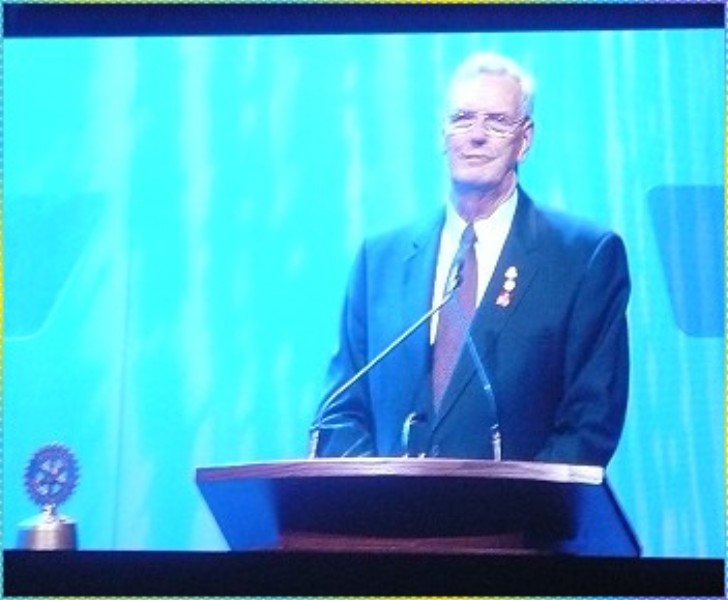
Dr.
Robert Scott's lifetime work to fight polio
EVANSTON, Ill., U.S.A.
(May 9, 2011) COBOURG -- For three decades, Dr. Robert Scott has
been a Rotarian and advocate for worldwide polio eradication.
Born and raised in Edinburgh,
Scotland, Dr. Scott immigrated with his wife, Ann and four children
to Cobourg in 1966. A general practitioner, he joined a local practice
and happily settled into rural Canadian life. "We wanted to
settle in a small town, not a big city," said Dr. Scott. "Through
a friend of a friend of a friend, I heard about the practice of
Dr. Jack Leeson. On the shake of a hand, I came for one year and
stayed, no further hand shakes necessary."
In 1971, Dr. Scott was
invited to join the Cobourg Rotary Club. He continued to practice
medicine until 1996 when he retired. Gradually over the years, said
Dr. Scott, his Rotary work began to take over more and more of his
time. From July 1987 to June 1988, Dr. Scott was the District Governor.
From 1996 to 1998, he became one of 19 elected directors for Rotary
International. In 1997, he was appointed Rotary International Board
of Directors Vice-president and if that wasn't enough, in 2004 Dr.
Scott was appointed a trustee on The Rotary Foundation Charity Board
by Rotary International.
The foundation board
is made up of 15 trustees appointed by Rotary International for
a four-year term. After three years on the board as a trustee, Dr.
Scott was elected by his fellow trustees to be vice-chairman of
the board. Due to unforeseen circumstances, he became the chairman
from 2007 to 2008. "It's what I call the 'Miss America Rule',
if the person who is elected chairman is unable to serve for any
reason, then the vice steps up," said Dr. Scott. "Only
17 days into his term, the chair gave up so I virtually had a full
year as chairman, apart from 17 days."
"When I became
chairman of the foundation, I was really quite delighted,"
he continued. "It was an amazing situation." Through
his work and association with Rotary, Dr. Scott has been working
tirelessly toward the global eradication of polio since 1979.
In September 1979 for
the first time ever, Rotary International sponsored a day in the
Philippines where all the children under the age of 15 were immunized
against Polio, said Dr. Scott. Clinics were setup across the country
to administer the vaccinations. "That was how we started,"
said Dr. Scott. "As compared to today, it wasn't very well
organized but we did it. By 1985, it was decided by the board, that
we would supply polio vaccine to any country that requested it but
didn't have money to do it."
Rotary International
as a whole began raising money for the new initiative. In 1988,
they raised $247 million, with over $1 million coming from this
district (of which Dr. Scott was the governor). Since then, a spearheading
cooperative of organizations has formed between Rotary International,
UNICEF, World Health Organization (WHO) and Centre for Disease Control
(CDC) Atlanta to follow through on the global polio eradication
initiative.
Most recently, the Bill
Gates Foundation has been increasingly generous and interested in
assisting with the initiative, publicly stating it's the number
one objective of the Bill and Melinda Gates Foundation. "After
our first fundraising campaign (in 1988) we all thought polio will
quickly disappear," said Dr. Scott. "We started with 125
countries with 1,000 cases a day, this year we're down to 1,000
cases a year. So we're 99.9 per cent there, we're now down to four
countries that have never yet eradicated polio, that's India, Pakistan,
Afghanistan and Nigeria."
Now the Chairman of
the International PolioPlus Committee (a sub-committee of the foundation)
for the past four years, Dr. Scott continues to work toward a polio-free
world. Next up Dr. Scott will be travelling to Chad and Namibia
as well as India to continue the fight to eradicate polio.
Copyright © 2003-04
Rotary eClub NY1 * Updated 2011
Design & Maintenance of this site by TechnoTouch
e-Strategists

